Post-Event Report - Onam Games by FOSSMEC
What is your name?
Ewan John Dennis
What’s your Club’s name?
FOSSMEC
Event name
Onam Games by FOSSMEC
Event type - Knowledge session or hands-on
Hands-on
Explain the event briefly:
Link: https://onam-games.pages.dev/
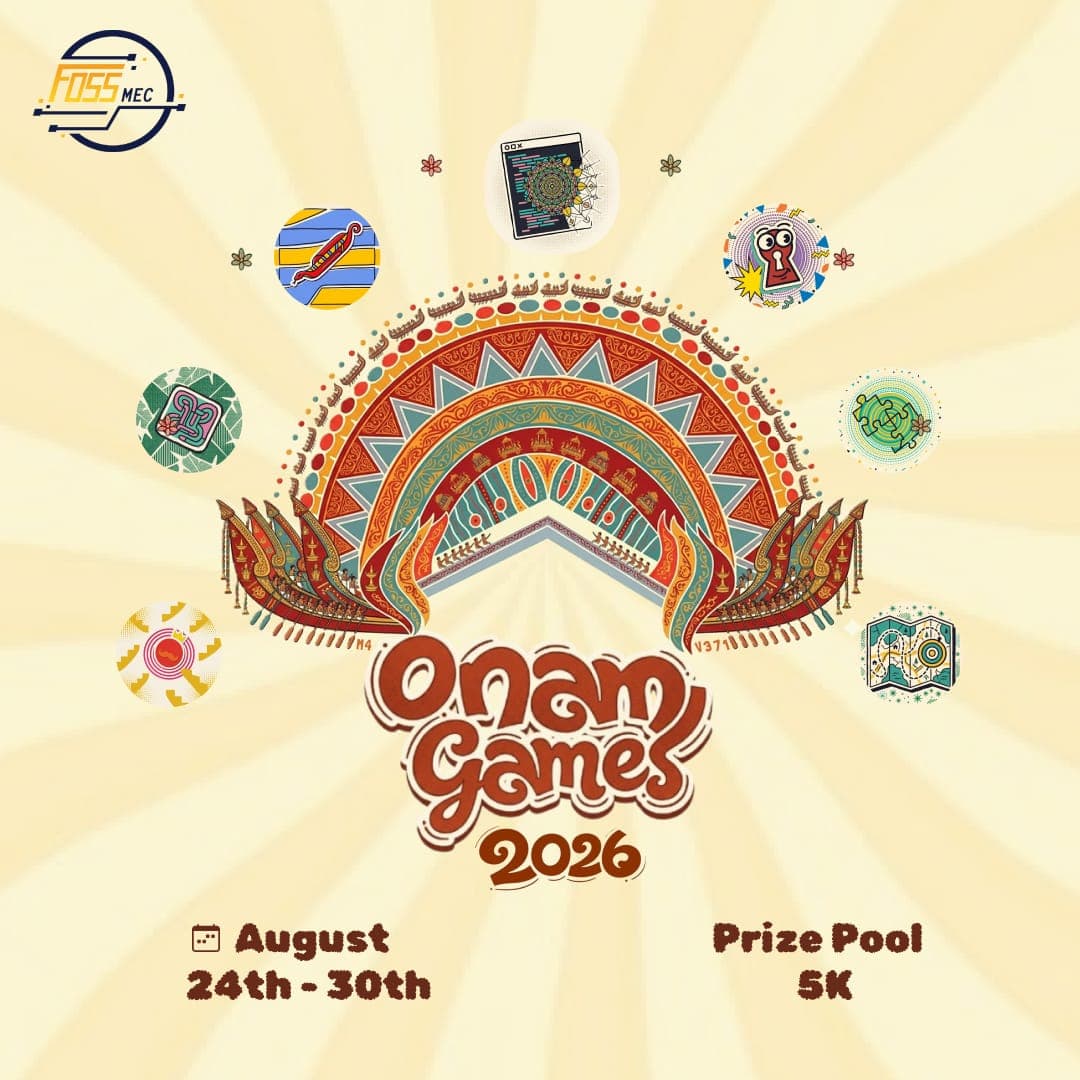
Onam Games was a 7-day online game series run by FOSSMEC during Onam 2026. A new game went live every day, each themed around Onam and FOSS culture. The games included Boatlock (an unblock puzzle), sudoWend (a word connection game), Maveli Jump (an endless jumper), FOSSwipe (a FOSS vs proprietary swipe game), Pookalam Jigsaw (a timed jigsaw puzzle), The Hunt (a treasure hunt), and Code-a-Pookalam (a creative coding and prompt engineering challenge). The event had a live leaderboard, a prize pool of ₹5,000, and a community Pookalam canvas. It drew 611 registered users across 55+ institutions including MEC, NITC, CUSAT, and working professionals from companies like Infosys and EY, with 24.4% of participants coming from outside MEC.
Speaker Details (if any):
Not applicable. Onam Games was a self-run online game series with no external speakers.
Was the speaker provided to you by FOSS United?:
Not applicable.
Mode of the event
Digital
If Digital or Hybrid, share the livestream/recording link
Not applicable. Onam Games was an interactive online game platform, not a session-based event.
How many people attended your event?:
611 registered users across 55+ institutions. 534 users completed onboarding (87.4%). The platform recorded 3,873 visits with an average session time of 5 minutes 36 seconds, totalling over 15 days of cumulative platform engagement.
What went well at the event? Tell us about your team’s execution and attendee response:
The event exceeded expectations on almost every metric. Maveli Jump became a viral loop with 4,874 attempts across 223 unique players, averaging 21.8 plays per user. The platform had a 99.8% visit engagement rate with only 6 single-event bounces out of 3,873 visits, far below the industry standard of 40-60%. Day 6 (The Hunt) drove the highest traffic day with 12,092 events and 619 visits. The Code-a-Pookalam challenge received 16 approved submissions and 5,800 community votes across 146 voters in 24 hours. The community Pookalam canvas saw 14,006 live edits with 2,496 out of 2,500 cells filled. 38 players maintained a perfect 5-day streak, and the event organically reached participants from 55+ institutions across Kerala and beyond.
What could be improved? Tell us about your team’s execution and attendee response:
The Hunt had a very low completion rate (4 out of 130 participants completing it), suggesting the difficulty curve was too steep for a general audience. Code-a-Pookalam had lower initial registrations and required a targeted outreach push mid-event to drive participation. Better pre-event capacity planning and game difficulty calibration would improve the experience in future editions.
What open source tools did you use at your event?
Supabase: An open source PostgreSQL database platform used for storing all game data, user profiles, leaderboard records, and event statistics.
SolidStart with Vite: An open source full-stack framework and build tool used to develop and serve the entire Onam Games platform.
Were there any challenges in using those tools?
The biggest challenge was hosting. Free hosting tiers have significant limitations when working with SSR frameworks like SolidStart, particularly around edge caching and server-side rendering support. Both tools were also relatively cutting edge and still in beta at the time, which meant navigating limited documentation and occasional instability during development and deployment.
Was one of those tools a crowd favorite?
Not directly applicable – both tools were used on the backend to power the platform itself and were not directly visible or interacted with by participants.
Link us to the contributions that your community members made at the event, if any?:
The community Pookalam canvas saw 2,496 cells filled with 14,006 recorded edits, replicating a collaborative Reddit r/place style experience at campus scale. Code-a-Pookalam received 16 approved submissions from participants.
Did you find anybody at the event a good fit to be a mentor or speaker at future events?:
The event surfaced strong engagement from participants across institutions like NITC, CUSAT, and working professionals at Infosys and EY. We will follow up with top performers and active participants for future collaboration opportunities.
Did you spend any money on the event? Give us a detailed breakdown:
₹5,000 was spent on the event, covering the prize pool for daily game winners, Code-a-Pookalam podium prizes, and a best voter award. A portion also went towards deployment and hosting costs to keep the platform running through the week.
Anything else you would want to note down for later?:
Onam Games was FOSSMEC’s first attempt at a multi-day gamified online event series. The format – a new game every day with a live leaderboard and a running prize pool – drove consistent daily engagement and organic reach well beyond the host campus. The event proved that FOSS-themed interactive experiences can drive strong community participation and is a format worth building on in future editions.