We welcome all IndiaFOSS volunteers to write about their experience volunteering at the festival (both remotely and on-ground). This documentation is very crucial to event planning. It helps future volunteers understand their responsibility better and also fix the mistakes we made this year!
Booths at IndiaFOSS 2026
Booths have become an important part of the IndiaFOSS festival, and participants spend a lot (if not most) of their time at the community expo. Showcasing projects and communities also have a lot of fun at the expo, and the number of applications has only increased in the last 3 years. We did a lot of experiments with booths this time -
- Single day booths - 10+ booths showcased for one of the days of the event
- Shared booths - Multiple projects shared a single table - SOCH + BCI, Chitra and Sanka, Sanchaya and Servants of knowledge
We also put a lot of thought into booth outreach this time. IndiaFOSS has transitioned from a FOSS conference to a “Digital Commons Festival”, and the community showcase this year was a good signal for this. We categorized (and placed) the booths thematically, and here are some numbers -
- Hardware - 10
- Education and Community - 11
- Devtools, Infra, Applications - 8
- Linux/OS - 6
- Privacy - 5
- Knowledge Commons - 14
- Civil Society - 17
Notably, more than 40% of the booths belong to the Knowledge Commons and Civil Society categories. We want IndiaFOSS, the “digital commons festival” to act as a big tent for the entire ecosystem, enabling these orgs and communities to interact with the FOSS community and -
- Talk about their use of FOSS/technology to create impact
- Create a shelf of problems that aspiring technologists can work on
We are very happy with the reception that the community showcase is receiving, and only want to expand it next year.
That said, a few things went wrong -
- We did not map out the first floor area in advance. While we knew which “category” of booths goes where, individually mapping them would’ve taken only an additional half an hour, but would’ve saved a lot of last minute time and trouble for both the volunteers and booth managers.
- The showcase area was empty for some parts of both days. We have a LOT of participants at IndiaFOSS, and the community showcase makes for a good opportunity to hold crowds during peak hours (invited talks/panels, lunch breaks).
- We noticed some booths were left unattended for extended periods of time.
- It’s unfortunate that the Hardware community always ends up unhappy with placement. Hardware is “visual” and needs better placement. Last year, we brought them to the ground floor outside Audi 3 to give them more space. They felt that area was secluded and did not get enough eyeballs. This year, we put them in a bigger room on the ground floor to curate a “hardware showcase room”, but ended up putting them in a box, which was not noticeable to many people, and also got cramped. I think it is best to put the hardware booths upstairs next time.
- Issues with last minute communication, ticketing, TVs, Wifi, etc. We did better this year on these fronts but there is always scope for improvement.
I had a long chat with Richi, one of the organisers of [FOSDEM]( FOSDEM 2027 ). FOSDEM has almost 100 stands at the event, and suffer the same space problems as we do. They have creative ways to curating and placing stands, and also ensuring they are staffed for the entirety of the event. The IndiaFOSS community showcase aims to be even broader than FOSDEM (in the sense we want “non technical” communities to feel at home here), so we want to ensure more projects get to showcase in future years. I have a few ideas for this (yet to be discussed with the team) -
- Very few booths will get to showcase on both days. If they do, they need to have a minimum of 4 booth managers who rotate over the course of the event).
- Communities that do not have enough person power to manage their booths should apply for single day and/or shared booths. This also increases their chances of selection (we had to reject more than half the applications this year and this will only get harder with time).
- Leaving the booth unattended should strictly not be an option. FOSDEM makes it very clear that unattended booths will not be selected in future years. At our end, we should make space for faster food and coffee access, more water stations etc. for booth managers if we want to mandate this.
- I want to use the glass area (usually used for FnB) for showcases - this is of course a bigger logistical question that needs more discussion.
Until we are able to move to a bigger venue, these feel like reasonable guidelines to ensure a bigger and better community showcase that accounts for the constraints we operate in.
If you showcased this year, please feel free to reach out to booths.indiafoss@fossunited.org with feedback, or post [here](IndiaFOSS 2026 - Feedback - #23 by Shree_Kumar)
2 Likes
3 Likes
https://medium.com/@thisisselva18/2026-q3-report-indiafoss-26-more-d3fcb9293426 - notes from a volunteer at indiafoss 2026
2 Likes
Well, I had a fascinating experience as a volunteer at IndiaFOSS in terms of managing the booths on the day of the event and prior to the event as well.
- The pre-event mapping of booths was particularly good, but the offline mapping could have been done a little earlier because on day 0, there were several booth members who came to the venue who had their booth scheduled for day one, but they did not have a space allocated yet. That’s something which can be improved.
- The space for each booth should also be a little more; currently, it’s a little too congested. With the current setup, only a maximum of 4 or 5 people can listen to what’s happening at the booth, so the booths could be better spaced out in the future to accommodate more people at a booth
- The workshops particularly can be planned a little better. There were minor issues with regards to internet connectivity, ventilation, etc.
The above were just some of the minor issues, but overall, since it was my first proper conference both as a volunteer and as a booth in charge for a project which I’m closely working on, it was a fantastic experience and I’ve never seen a conference as good as this.
Most of the proceedings were very smooth; however, there were some minor hiccups and challenges which is bound to happen, and there’s always room for improvement in the future.
I’ve listed some of the issues at the top of my head in the message above, but I’ve also written a detailed post on LinkedIn. I’m attaching it below for you all to read.
4 Likes
My second year as Co-Chair. Felt much better. I learned a lot, and also the year when I now understood what needs to be done next. Read my last year’s notes too, for full perspective on this.
This year the conference didn’t feel a “blur”. We had way more volunteers helping out. More technical volunteers too, if I may add. The video livestream had @Mohd_Yasir_K_N @Muneer_S @Tablaster and @Jasil, assisted by 16 volunteers from PointBlank club. We covered the rest of the conference too - more photos, more videos and more fun courtesy a 20+ member student volunteer team from 3 colleges in Kerala led by @Ganesh_Adimalupu ! For the second year running, we spent a lot of time planning stuff and many hours in meetings starting with 2+ months to go for the conference. We also had a custom stream based on Free software courtesy efforts of @Jasil and @Tablaster . I’m personally glad we crossed the finish line and actually put this out. We also fixed a lot of audio noise courtesy moving to a digital mixer. We spent about 20k extra for this. Worth the money I’d say. Our livestream is mostly usable out of the box. And we have 4K recordings which have to be edited next for high quality output worthy of India’s best truly volunteer run conference ! 
We spent around 1.3 L on equipment rentals, 30k for a 2 TB HDD, and maybe a few thousand more on accessories and misc things. Add 60k for travel for video volunteers, and a bit more for livestream, maybe stay and food costs. That’s somewhere slightly beyond 3L I guess. Great return on investment - more outcomes and happy volunteers (I hope!). A full on quality evaluation is still sometime away, but I’d say that we proved that to cover the event, we don’t need paid “professionals”. More power to volunteers and volunteering !
We also had the brilliant and chilled out Networking team led by @Mohit_P_Tahiliani and his team from COSH, NITK, Suratkal. They cheerfully laid out the network, and didn’t loose composure even at 2 AM - calmly delivering authenticated secure network access to over 2000 accounts. I felt somewhat sad that around 500 logged in, out of 2450 or so folks that we created accounts for. But this could also partly be attributed to many of them having adequate connectivity and not feeling the need for connecting to a WiFi connection. They have collected a lot of network data, so I’m hoping in the days and months to come there will be more fun insights coming out of this! @Mohit_P_Tahiliani showed a great level of initiative not only in finding us a network sponsor, but also stepping in just the right amount at the right time I’d say. The 1 AM/2 AM stories would have to wait for another day. Well done, Prof ! And students, thank you again !
The devrooms were a highlight for a second year running, coordinated well by @sumit_semwal . The only question we were left asking was - how come we didn’t run them at a larger room ? Once or twice I actually counted. Devrooms had more people inside them than either Hall 1 or Hall 2 - running the General Track. We’d have to rethink how to allocate space next year. Rick Hartman from FOSDEM had words of praise for our implementation of the devrooms. That was an unexpected bonus for me personally. As we scale devrooms, we must strive to keep the close knit feeling.
Overall logistics was well done. It didn’t change much, but credit must goto @Suslime for delivering most things. We need to start using “dumb TVs” next year - everyone uses a cable, and the remotes are a serious pain.
And we must certainly just “give” network to sponsors first thing as they enter - if we have any network at all  (note for self)
The 1 day booths were a good thing @ansh. I’m generally happy with the overall coordinated effort on the floor @siddharth_shivkumar1 @Vrinda_Gandhi . We had good election results too, and credit to @rahulporuri and @ashlesh for coordinating this - and finding a FOSS election vendor 
@ashlesh overall repeated a stellar performance with comms.
I didn’t get much time to sit and enjoy the talks, but caught bits and glimpses of the action. I enjoyed the expressive MCing of @sthirkal in Audi 1 ! Had a bit of fun at Communi-Con myself. Looking at the videos I have much to learn.
Communi-Con was a fun thing. I got the idea from the hardware devroom voting system and @hritik’s feedback. Was ably helped by @Amit_G and @Balu_B - they spun up a voting system just for this, and I’m glad many of us had a blast !
@Dilip_G was able to solve most of my queries, and I was happy to be able to get my hands on data required.
This year we tried to improve main track curation. @James_Reilly had a good idea about reducing the number of talks that went for full on reviews. We dropped 25-30 proposals that all of us felt lacked enough substance for further reviews. Beyond that, we enrolled 20+ reviewers in an attempt to get timely reviews done. That didn’t exactly go completely to plan, but went better than last year. I’d say we did better in terms of curating based on “overall fit”. We skipped mocks for some, did mocks for some for an accept/reject decision, and some mocks purely for feedback. Workshops could be done better though. BoF selection process was good - complementary to the talks. Once you curate talks, complementary BoFs and take that stand that Panels have to be complementary to all that content - then the space for panels shrinks further. Meaning external proposals have much worse chances for selection - so why ask for them? Panels for next year must be purely invited I suppose. We were almost done with most selections with a month to go. Not too bad. The way we put together the schedule - a collaborative effort - felt reasonable too.
We only had 2 invited talks this year. We could have had just one too. To be honest, we tried quite a bit. We wanted a max of 4-5. At-least one of our invited talks may happen in IF27 !!
Coming to the negatives… One thing stood out for me - our overall lack of process improvement compared to IF25. Last year @ansh handled most of the platform, reviews, etc, and I was playing a somewhat supporting role. This year, I took on the lead role. And found why many things are a pain. It’s clear that the platform is designed mostly for small events - city meetups and the like. Doesn’t mean we can’t fix it (still haven’t given up hope on this), but doing so requires a clear understanding of what the workflow should look like, and clearly tracking mistakes and quality metrics. E.g. did we really have to send out so many emails, what should be done and in what order, when to collect what information from who, what are the tools we really need to build, and how to plan “backwards” from the event date. To be honest, I don’t think the FOSSU staff can correct this unless they sit for a few weeks and figure out what the fixes must be. And that’s what they must do now! I have made a note for waterfall development for the platform in my GB reflections talk. Of course we should look at the NIH angle - and see if pretalx is a better alignment with IndiaFOSS. We should also look closely at what needs to be improved - e.g. ticket transfers are generating so many emails, confusions, etc.
Our outreach needs better structure - media outreach (e.g. Nikhil Pahwa) must be done months in advance, in the planning stage. Social media outreach must be used to sell tickets. Not much point doing it when most of the tickets have been sold We must look to move timelines further back to get in more sponsors - generate peaking SM interest 2 months before the conf etc. Much strategy to be deployed for best results. That said, our talk solicitation outreach was much better @rahulporuri , except for the loads of emails generated to indiafoss!
And finally, diversity. IF 27 absolutely absolutely must have bulk of travel grants given out with 2 months + 1 week to go for the conference. Train tickets the norm. And any flight tickets must have strong reasons.
And email templates, documents, etc - we must fold in all our learnings and put them into all templates decided waay earlier - rather than closer to the conference. Our CFP must not need people looking at 3 different places, and it must be clearer to folks what they are signing up for e.g. General Track means what?, Devroom CFP must be visible after the proposer selects the track - so that they clearly know the scope etc.
I am happy to help the FOSSU folks to fix many/all this, but I will strictly do so in the role of a “mentor”, not as a “volunteer”. I’ve figured that the “volunteer” label can create sub-optimal results at times, leading to other “volunteers” ignoring useful suggestions due to what I consider their “opinions” not based on any “data”. Now, that is par for the course due to “growing into roles”, but the detrimental effect I’ve found in this is that this is not “inclusive” for older folks like me, who may not want to spend too much time convincing people to fix easily solvable mistakes. Where is this all coming from ? Professionally, I am quite a task master, I do expect a level of perfection from folks doing this as their primary jobs. And I have to be fair - nobody in the entire conference has actually worked with me in a professional capacity in IT, except for the breakfast vendor!! (quite pleased to see them fix all the breakfast feedback from last time btw). I strive to build systems and do them fast, and effectively - and I am somewhat surprised that even in spite of folks using so much AI, we’ve had such choppy processes. (waterfall again) All said, building good processes needs much experience.
Does that mean I made no mistakes ? Nope. I was directly responsible for the “Hall 1/2/3”, “Room 1/2/3” labelling - even overriding @Jeswin (good job with the signage, man!). This left some people confused - as the rooms had large markings saying “Auditorium 1”, etc and “Boardroom”. We had standees right next to that - and I have no idea why - and there were tonnes of people around to ask - like your fellow conference attendee but I’d still take the ownership of this. Feel free to point out anything else that were clearly my doing
I must have spent about 2 months of my time organizing IF26, and that time spent has given me a clearer idea about a lot of things. What IndiaFOSS must be in, in 2027? was my Communi-Con talk. Nobody here knows that most of those slides were made a week before the conference. I probably pulled the biggest “Con” job in Communi-Con - and just about made it in with 41 votes. Thanks for everyone who voted for me. Phew!
There’s much more I could write, but in general I feel it’s important for us to scale the conference using all the tools available to us - technology, people and networks - all of them. @James_Reilly made the conference planner app, and I feel we haven’t even scratched the surface of what we can do with that. It could become a venue guide, ticket and more for - Push messaging for notifications etc and more!
As an outgoing member of the GB, I’ve had the realization that FOSSU is a “Community of Communities”, and that’s how we can achieve best results - by valuing all of the below - and letting all of them act in parallel and unison, towards shared goals:
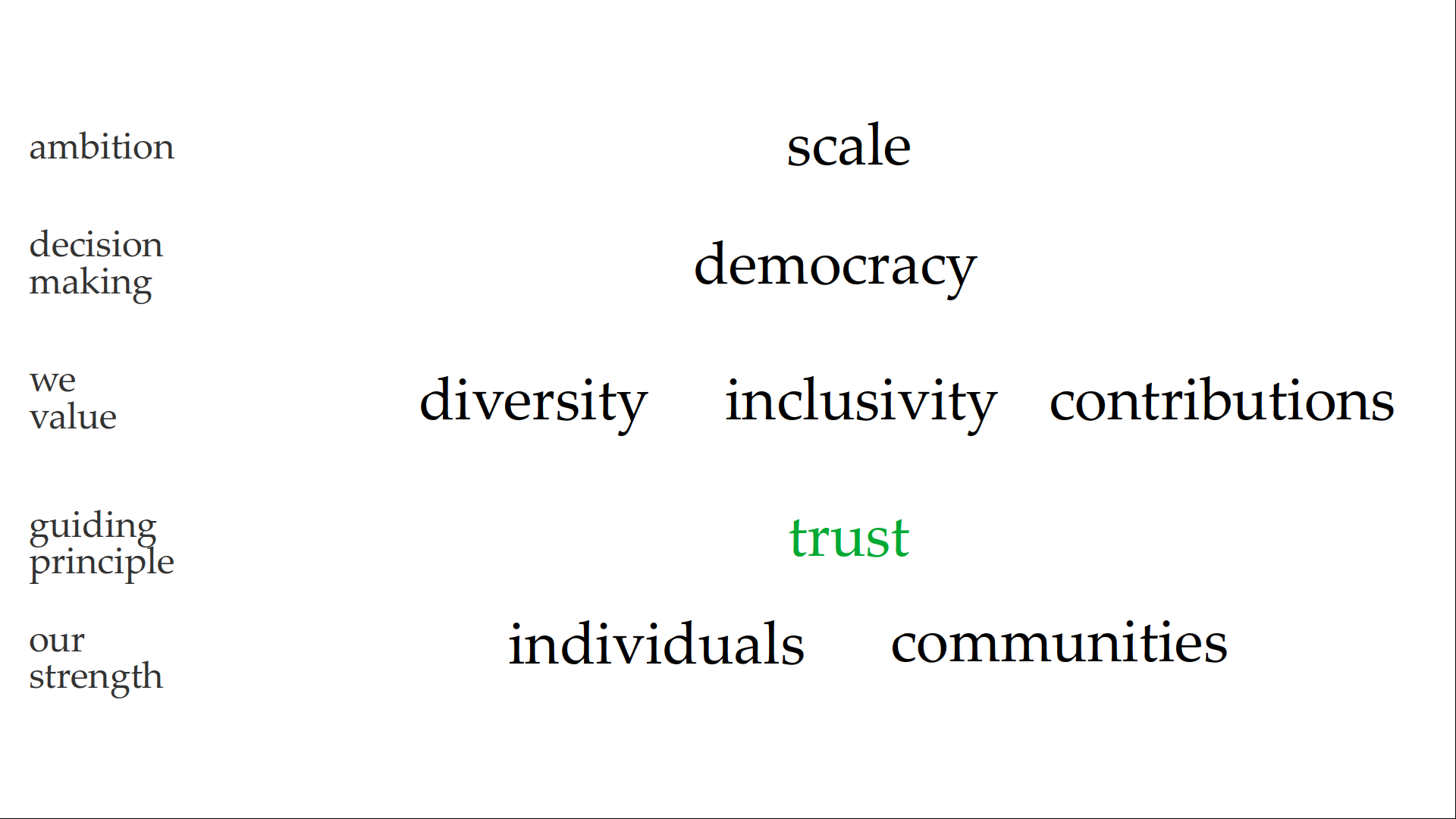
Many of us have aspirations for FOSSU to be “Community-Led”. But how-to translate this to execution ? Simply put - someone from the community has to lead first ! Take on the overall execution. Rally volunteers, staff, community, etc. Now that’s something I am happy to take up. There’s tons of things that we can do - and we can do it all next year. We just have to keep an open mind and empower people to do what they do well.
All this made me think how best I can help for IF 27. I’m veering towards taking the role of DEI Chair, stepping away from curating the General Track. Can also help with logistics. If we are to scale our proceedings, we have much work to do around the year, so somebody local it will have to be. I have time on hands, and the energy too LOL. I can also see some more oldies putting up their hands for such tasks (@Vasundhar !). Will look to hand this over to other volunteers over time, much like I have now done for livestreaming.
Further, I’ll advocate for IF27 to be the focal point of all “events” where FOSSU play a major role. Meaning, let’s merge FOSSHack into IndiaFOSS '27. FOSSHack could start with IndiaFOSS and run for a month. Best way to put to use all the skills, ideas and networks generated at IndiaFOSS - right now after we all say tata bye bye at the conf, all the energy dissipates!
So what should be the role of FOSSU staff over the next year ? Oversight, primarily. Plus helping the regional event grow, networks grow. There’s a lot that is done well - and I am already on record saying that I really liked that we made a start with the Awards, getting in diverse communities etc - all that is hard work and we want them doing more of it. And the only way I can see us going is UP.
Lastly - a word on how we pick volunteers and grow the conference and movement itself. We run various events - Mangalore FOSS, Mumbai FOSS, ChennaiFOSS, PuneFOSS, LucknowFOSS and various city meetups. My suggestion is that we look to source more volunteers from this pool - ideally as teams. This way, IndiaFOSS acts as a two way street. Helping build local capacity and enabling flow of processes in the reverse direction. Some will argue that this is already happening, but my point is that this must be a formal process - as in we ask the city chapters and large meetup organizers to suggest “volunteers”. They themselves can do a call for volunteers, whet them, volunteer their own core teams, etc. This helps by reusing teamwork. This way the entire network is strengthened and grows by building on earlier results. All that said, we must have a quota for volunteering that runs on serendipity - but it must be way smaller, and must not make up the bulk of volunteers. Online volunteering might become a thing for IF27 too. Things like livestream monitoring, design etc could majorly benefit from this, and can be easily done sitting at home.
5 Likes
By the end of day 1, I’d walked around 20,000 steps and 14 km
1 Like
Missed mentioning this in my previous note - or maybe I was unsure if I should post this at all? Calling this out separately, as this matter merits a good solution.
I had a bit of fun running around asking for votes for my Communi-Con talk. Somebody told me that it wouldn’t work because most of the staff didn’t have tickets  I had tied the ticket to WiFi, and Communi-Con - and had talked about this enough. So this came as a surprise to me. I was course annoyed by this discovery…
I was in charge of generating Wifi credentials, so I have the list of tickets (2452) of them. Got it from Dilip late on Day 0. Here is the list of staff, their roles, and whether they had/didn’t have tickets:
| Role | Name | Had Ticket? |
|---|---|---|
| Director | Vishal | Yes |
| CEO | Rahul | No |
| Programs & Partnerships Manager | Ansh | Yes |
| Campaigns & Advocacy Manager | Ashlesh | No |
| Software Engineer | Dilip | Yes |
| Graphic Designer | Jeswin | No |
| Diversity and Operations Manager | Ruchika | Yes |
| Learner Programs | Siddharth | No |
| Program Associate | Vrinda | No |
| Intern - Campaigns & Advocacy | Ananya Arora | No ? |
| Intern - Programs | Kratika Tekwani | No |
| Intern - Campaigns & Advocacy | Sadhana | No |
| Intern - Tech Intern | Siddharth Bansal | Yes |
Feel free to correct the table.
And before any of you now jump and start thinking - "Oh - Rahul the CEO of FOSS United didn’t have a ticket !? That’s really bad… " that’s not what I am saying. This is a classic case of process improvement in the “platform”. Among the Co-Chairs, James didn’t have a ticket. But I had, because I had a BOF which was approved. I think Ansh also had a ticket because of his panel. But apart from that I don’t see a logic to this - Dilip didn’t have a session, but he has a ticket. And similarly Vishal too. And Siddharth Bansal - how did he get a ticket ? @Dilip_G perhaps you are the best guy to solve this mystery! Please help me out
PS: I had a ticket but didn’t checkin formally I guess. So maybe we have a slightly lower count than the real number of people we had at the venue. Not sure about volunteers?
1 Like
Platform for IndiaFOSS 2026
Although 2025 went smoother, this time some things got out of hand.
Reg Desk:
-
Checkins lagged a bit due to long queue, but thanks to volunteers idea, two person went ahead with mobile to do checkins at their spot and hand over sticket ID so clear the queue instantly.
Again i can only blame that ID sticker writing takes time for each. -
On tech side the data look long to reload for searching whole table which eventually costed more CPU usage in frappe cloud
Definitely need perf boost and make UX very simple with filters -
Compared to last time we had more people in Desk, Ideally Reg desk only needs 6 people with quick hands: scan > instruct (food + venue guide) > Sticker ID > send them off away
-
We should prefer stickers in sheet to avoid people throwing off peeled wrapper away, Sheets help us to handle waste, many of us had to pick these peeled wrap since desk was placed ahead of entrance in the middle.
T-shirt distribution:
-
Although most people collected t-shirts quickly, but we failed to collect t-shirt size with many ticket coupons, this needs to be fixed and let system collect all sizes when they claim ticket to ease the merch process. Git Issue
-
Again UX need improvement, to show multiple tally view of distribution to keep bundles separately for easy logistics.
-
My ideal plan was to hand over t-shirt during reg desk itself so we get rid of pre-paid or claimed ones, and let venue only sell for spot buyers only. This might need 2 volunteers along with 6 people above.
This makes two work happen in same place quicker and more easier, instead of creating double task.
RFC thoughts:
-
Should we allow self-checkin
Just like /my-tickets page we can show another page with self checked-in feedback thus easing the volunteers job.We can also plan to show custom messages during event, like WiFI credential and other sutff to keep them informed? or this can be unofficial companion app features
-
Present more API to users, so they can make community schedule and pages to cater group of attendees
We already have many API which James’s unofficial companion app used, we can pro-actively announce others to use and build handy stuff for Indiafoss. -
Devroom (miniconf or community rooms) should be federated on their own page, we can adjust platform to pull in and reflect the same here.
Eg absurd industries had their own page, thus we can ask a json spec and let pages be in sync, so fossunited alone does not govern these pages, managers make their own and we sync same in our platform.
This avoids manager needing to email and provide edits and even we in limited capacity not able to modify or design pages
Finally thanks to all reg desk, merch volunteers for helping out and doing a fantastic job.
The likely answer is we forgot to send ticket codes to staff members. Most of the people who have tickets in this list probably generated one for themselves, or got one since they were part of another list (speakers etc.)
Not sure about volunteers?
All volunteers were sent ticket codes but I’m guessing this only includes people who had submitted the volunteer form and got selected. Co-chairs, staff, and other volunteers we added on the fly would not have their emails in that list.
Here is what you are missing: I have flagged this as a “platform” issue, not a manual process thing. Most of the folks are listed under various roles in IndiaFOSS (“volunteers” if nothing else?), and IIRC that didn’t change in the last minute ?
Do we have a concept of “remote volunteering” - or are all of our volunteers (listed on the site) supposed to be coming to the conference - sorry I’m not sure about this. @Siddharth_Shivkumar perhaps you know this best?
The thing that stuck with me the most was, how it takes a village of people to do all of this. A village of people that care. You could feel the camaraderie and curiosity and the dedication throughout. The reviewers gave their time to read and weigh every proposal. The devroom managers took full ownership of their spaces. And the volunteers were everywhere, handling everything from network, media, logistics, food, registrations, booths and more.
3 Likes
Short answer - the process of issuing tickets to volunteers is a manual process and we forgot to issue to the foundation staff.
A tech fix to this will be to have an automation that sends anybody added to the IndiaFOSS website as a volunteer, cochair, staff etc a free ticket.
With respect to responsibilities, there are online (reviewers mostly) and inperson volunteers but they aren’t differentiated in any way other than when their time is needed the most. We are open to online volunteers joining us inperson but the two groups have largely been of different people.
2 Likes