OpenStreetMap Travel Grant Updates

April

LucknowFOSS

On the 4th of April, I attended LucknowFOSS. The turnout was great and I was excited to present…but my talk ended up being scheduled near the end, which meant only a tenth of the audience was left. The audience that was present seemed to be fairly engaged in the subject, and seemed to like the talk.

We had scheduled a mapping party the next day, but the turnout was quite disappointing - only 4 people attended, of which two were organizers (me and @niyabits), one was a participant at LucknowFOSS, and one was a stranger we ran into during the party.

We had hoped that at least the other LucknowFOSS organizers would attend, but it was not to be. The large number of people who had traveled from other cities to Lucknow all had plans to leave on Sunday (if not Saturday night itself), and could not attend. Nor did sending out emails a week in advance to the ~250 recently active mappers in the city seemingly have any effect.

This was the third mapping party hosted in Lucknow by me and @niyabits , and we were seriously demoralized by the poor turnout each time.

ChennaiFOSS

On the 18th of April, I arrived in Chennai to present a talk and host a workshop at ChennaiFOSS.

Hours before the event, I was informed by the organizers that what was to be a two-day event had been condensed into one day. (I learned later that this was due to venue unavailability.) The workshop would be held on the same day as the talk. Since I had the Sunday free, I decided to host a mapping party. I hastily sent out emails inviting local mappers, hoping that enough people would check in time.

This time I had made sure to request that the talk be scheduled before lunch for maximum reach, and my talk was scheduled right after the introductory note.

A lot of people I met had heard of OSM, but simply couldn’t believe that contributors like me existed in India :slightly_smiling_face:

I also met someone who expressed interest in hosting mapping parties in Kolkata - which was quite exciting to hear, and I need to follow up with them.

Some post-mortem notes I made were -

  1. I must start carrying my own HDMI cable, as the ones at venues are often too short.
  2. To prevent disruptions due to network issues, I should prepare more screenshots/videos to replace live demos.
  3. An iD workshop should not be less than 90 minutes in duration.

It is tricky to organize an outdoor mapping party in a city you’re completely unfamiliar with. The organizers helped me out by suggesting venues. The fast food place we met at was a bit noisy and crowded - not exactly conducive to talking about OSM and exploring some applications - but it worked out.

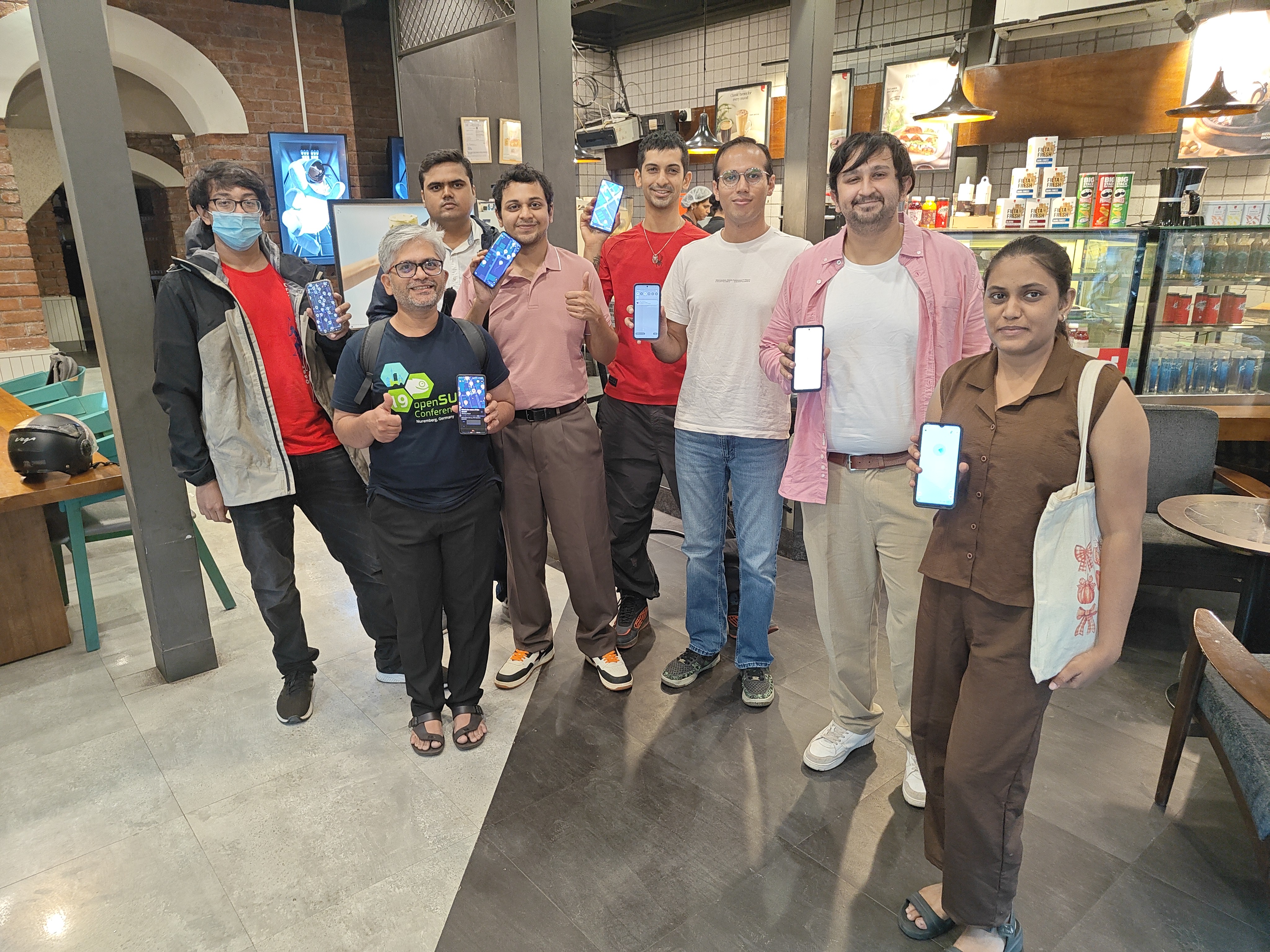
We got 8 participants in the mapping party, including me, and three friends - @perry, Varun, and Badri - from FSCI and Prāv. The mapping phase was fairly productive. Two of the local participants turned out to be very proactive, and have started organizing mapping parties themselves! This is exactly what we need in all cities of India :slightly_smiling_face:

3 Likes

May

May was a slow month. I attended the Maintainer’s Meetup in Delhi where I got to know about CoRE Stack and later reached out to them over email.

I really must start printing some OSM handouts to give to people. That would have been helpful at spreading awareness about the local OSM community.

Attending the Maintainer’s Meetup gave me a better idea of the intended scope of “maintainer” - from memory, “anyone who spends a significant amount of time and effort contributing to a digital commons project” - which should help me bring in more local maintainers who didn’t think they qualified as such.

I tried to go to the FOSS Meetup in Coimbatore, but my train ticket did not make it through the waitlist, and I was invited to give my talk online instead.

This was my first time presenting over Jitsi Meet, and I realized that it needs some extra considerations -

  1. Set up at least 30 minutes before the audience arrives, so we can test audio, get a good camera angle, etc, without making people wait.
  2. Share only one window (instead of the whole screen), so I can see my notes as I talk.
  3. Keep a little PIP window open to gauge the state of the audience. It’s quite disorienting not to be able to do that!
2 Likes

HillHacks

I had long heard of HillHacks, and in June I was finally able to attend it. It was a 5-day event held from Wednesday the 3rd to Sunday the 7th, and featured hackers from a wide range of fields - programming, network engineering, visual art, music, astronomy, photography, and (!) motorcycle modding.

The venue was a campground which was just a single node on OSM when I got there, so there was loads to map. I set about mapping the campground as an area, adding buildings, toilet details, boundary walls and fences, etc. This was also my first time mapping retaining walls and human-made embankments - common in the farmland of hilly regions like Himachal, not so much in urban plains.

I was pleased to find a number of OSM India folks present -

  • Mr. Satyakam Goswami - one of the OG contributors;
  • Arun Ganesh a.k.a. PlaneMad - one of the current top mappers of India;
  • Nihāl and Sāswata from the OSM Delhi/NCR community;
  • Kelvin from OSM Kerala;
  • Moksh, Rajudev, and Badri from FSCI.

Still, there were plenty of folks for me to introduce to OpenStreetMap :slightly_smiling_face:

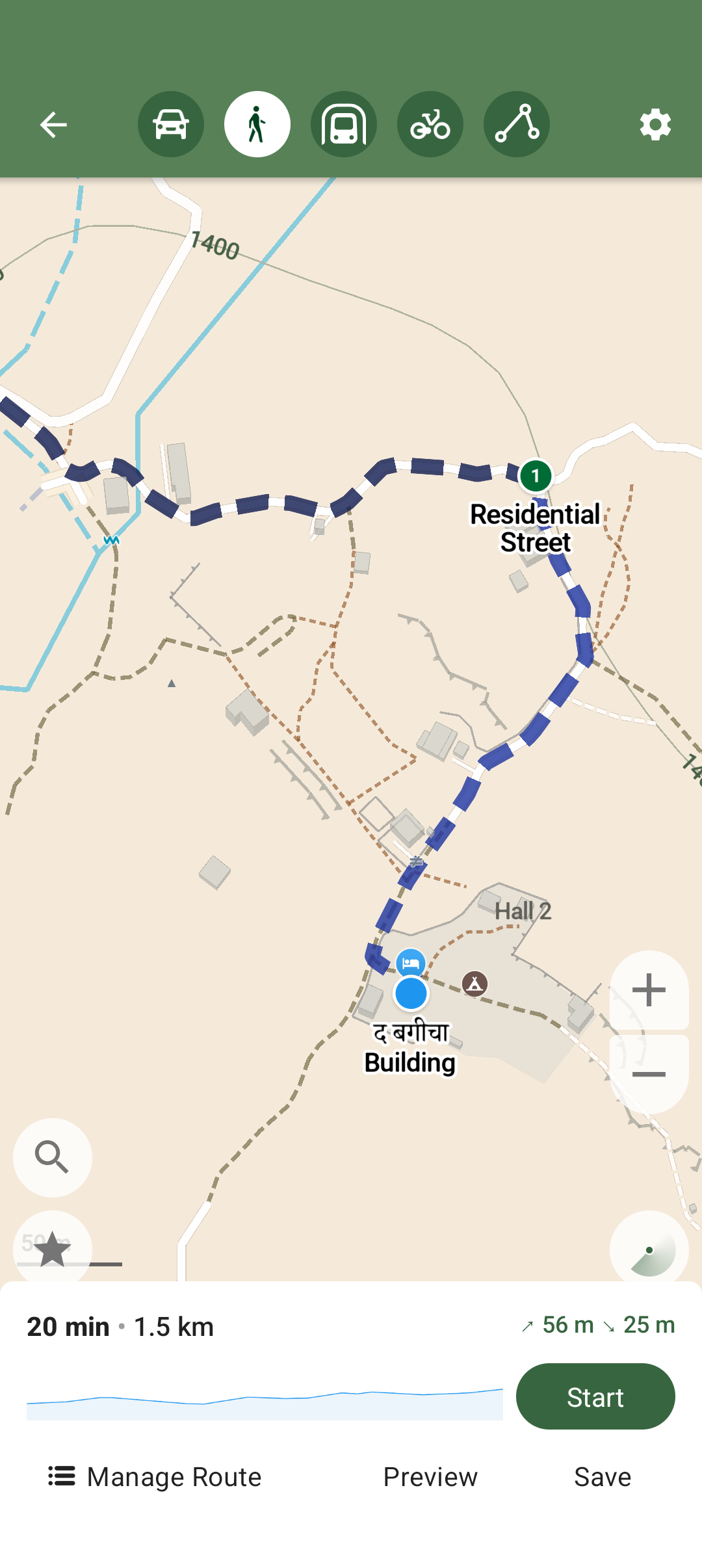
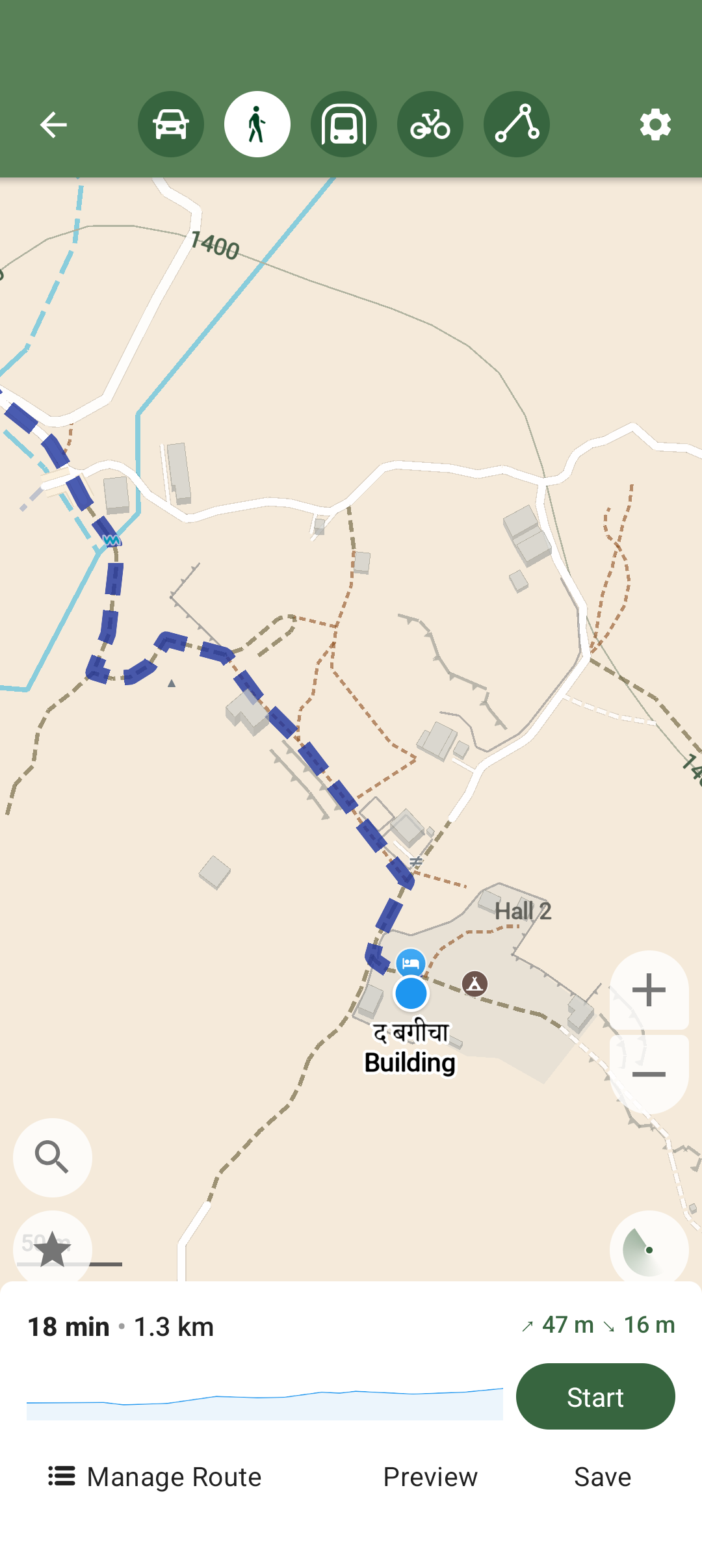
To go from the venue to the nearest shops (near Chaugan Chowk), you had to walk around 1500 meters…but one day I noticed that PlaneMad had mapped a little hidden dirt path that cut it down to around 1200 meters. OSM in action! :heart:


The original, longer route.

PlaneMad’s path.

One of the best parts of the trip was going on a hike led by Rajudev and accompanied by around 6 others. As you may expect, I was recording a GPS track the whole time, and mapping as far as the network permitted. I used the track to add my first-ever hiking path to OSM; it was also my first time using the sac_scale key to specify the difficulty of a path -

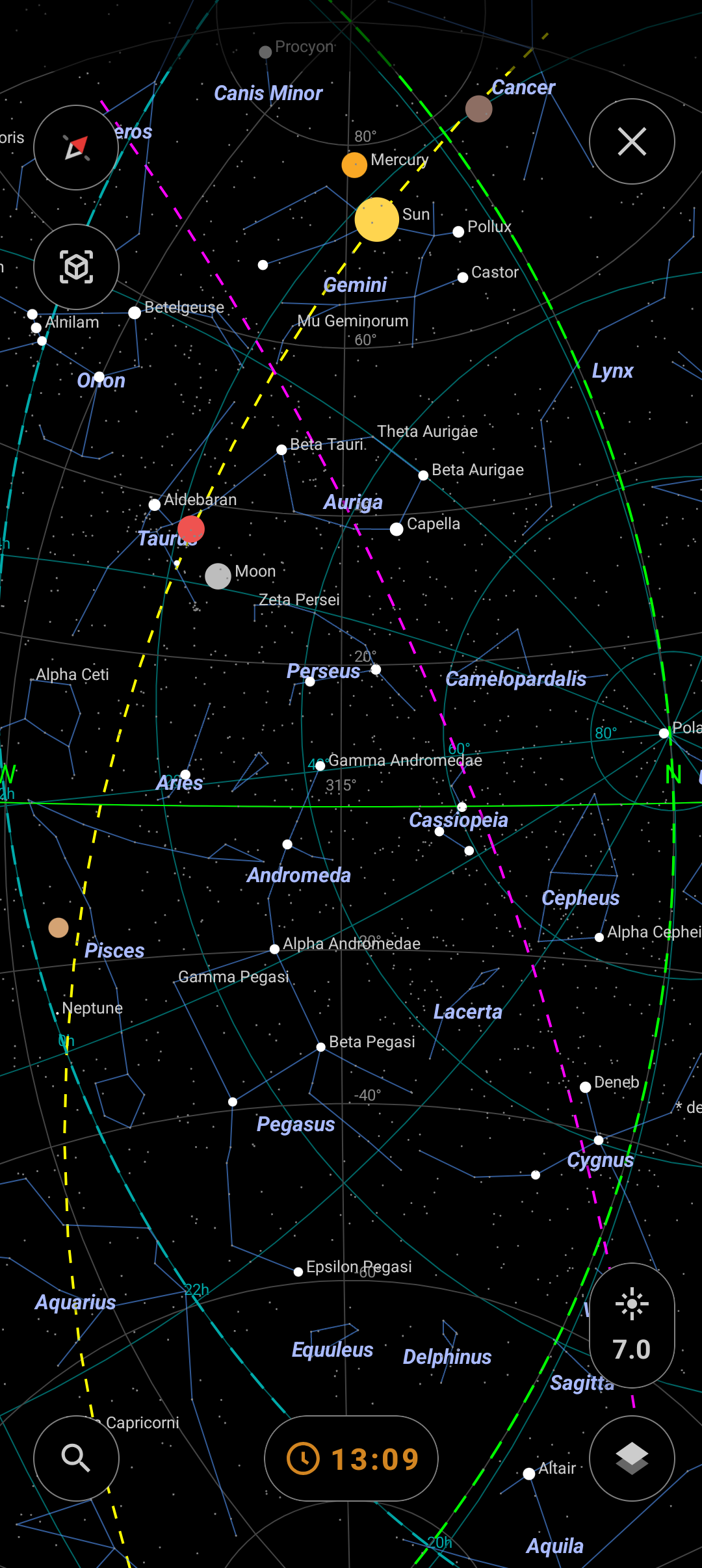
Malik introduced us to stargazing, through which I discovered that OsmAnd - one of the OSM applications I’ve been using for years - had recently gained an AR star chart mode!

The organization of the event left a lot to be desired. I had submitted a talk and two workshops (through the official event website) long many days before the event began, but was not allotted any specific time slots for them. I only managed to snatch away a slot for an indoor OSM workshop when someone else did not turn up for their talk. The workshop was okay-ish.

That left the outdoor workshop/mapping party. I constantly tried to make it happen, and there was significant interest among the participants, but it always ended up running afoul of the organizers’ plans - and out of politeness, we always acquiesced. Time and again I’d ask the organizers about scheduling it, but never got a clear answer.

Eventually, I stayed on an extra night to hold it on Monday the 8th, but it seemed futile -

  • most people who had come from other cities had left;
  • the local team was exhausted and did not want to go anywhere;
  • the organizers had yet more things planned on the day, which took up any remaining people.

In addition, the constant uncertainty over scheduling meant that this was announced at the last minute, so I was unable to send out email invites to local mappers.

We had a mere 3 participants and me, and 2 of them were like one hour late. While we managed to map a fair chunk of the market, I was furious about the organizational fiasco. We could have had so many more people, could have done so much more…“Next time,” I swore, “if an event does not give me a clear schedule in time, I will schedule my activities myself - and if it conflicts with the organizers’ plans, then so be it.”

With that, I returned to Delhi and headed for Mumbai for the string of events lined up southwards.

1 Like

PuneFOSS

On the 20th, I was scheduled to speak at PuneFOSS.

As I had requested, my talk was scheduled before lunch. I was glad to be presenting at a time when the turnout and the energy were both good.

While the talk seemed to be going well, I was somewhat taken aback when I was unexpectedly shown the “time is up” board. It seemed too early! I panicked, assumed that I had lost track of time, and skipped to the end of my talk, leaving out about 40% of my material.

Even as I walked back to my seat, with members of the audience praising the talk, I was quite confused. How could I have overshot the time? How long was I talking? Did they do something like including the time it took me to set up?

I asked one of the volunteers about what my actual runtime was, who helpfully pointed out that I could check the video of the talk. (I’m glad they recorded it - it’s the only recording of me speaking that I know of :slightly_smiling_face:)

Going through the video, I noticed -

  • at 01:17:07, the MC finished introducing me;
  • at 01:24:32 (7 minutes later), I finished setting up and started presenting;
  • at 01:40:45 (16 minutes since I started presenting), I look down into the pit to see the “time is up” board;
  • by 01:42:03 (18 minutes since I started presenting), I had wrapped up my talk.

No wonder it seemed too short…because it was!

I asked the organizers about why this happened, but did not exactly understand their reasoning - something about running behind schedule? But just about every conference I’ve seen has run behind schedule, and I’ve never heard of a talk being cut short on that account. Perhaps I should have trusted my own talk timer, and pointed out the issue during the talk itself… :face_with_spiral_eyes:

As usual, I had planned a mapping party for the next day, and had hoped to invite the PuneFOSS audience to it. But with the talk going the way it did, the invitation was part of the content that got skipped.

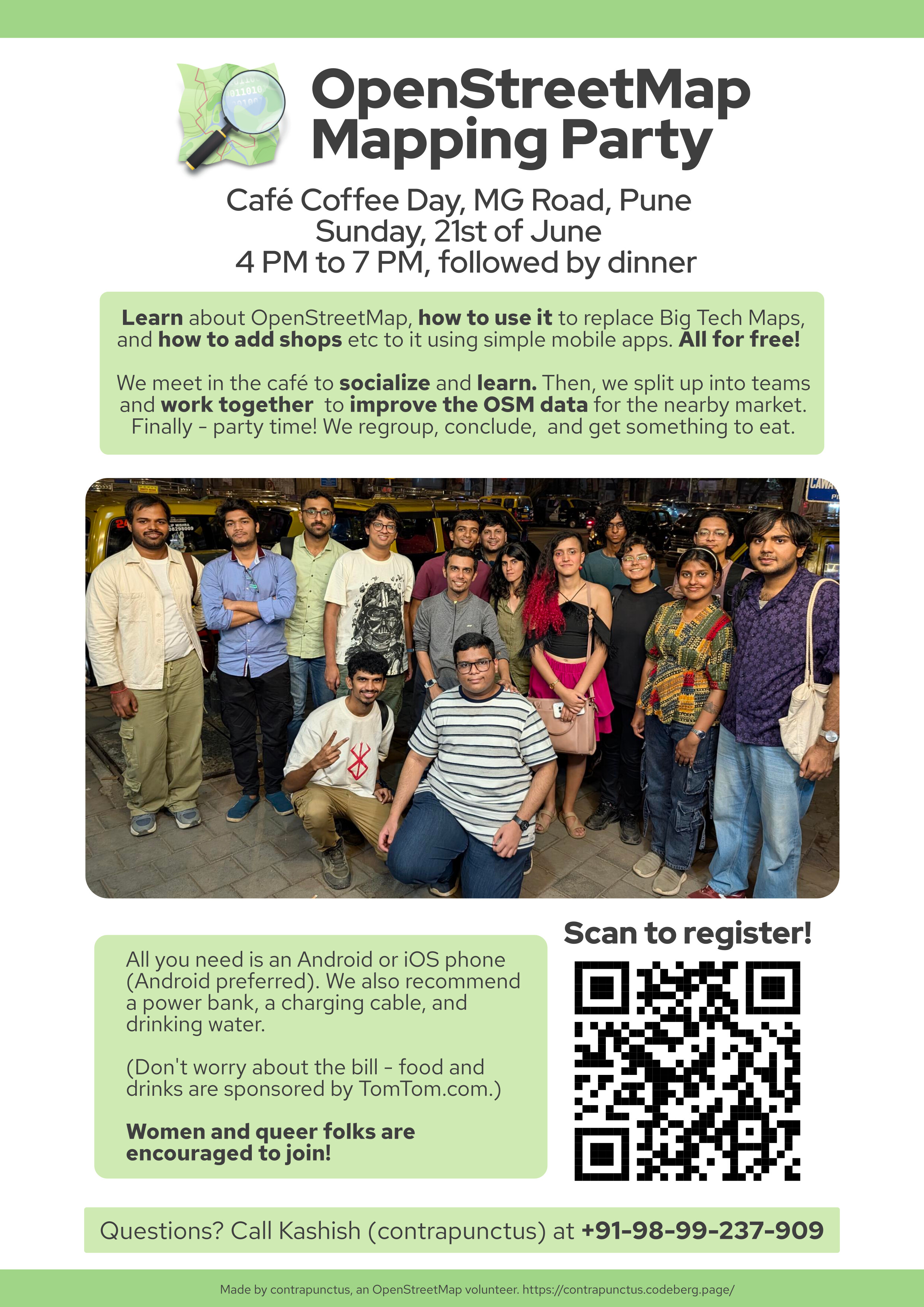
To remedy the issue, I spent much of the conference designing a poster inviting people to the party, then going out to get it printed. The venue staff didn’t let me stick it anywhere, so I just laid them out on the tables. But by this time it was past lunch, most of the people were gone, and we did not have a single person from PuneFOSS at the mapping party the next day. (Those from other cities would of course be leaving, but I had hoped that at least the local participants and organizers would attend.)

The next day, as we were on our way to the mapping party, it started raining quite heavily. My personal policy is to always go ahead - perhaps the rain will let up, and even if it doesn’t, we can at least meet up. In spite of everything, we got about 9 people. :slightly_smiling_face: And by the time we stepped out of the café to map, the rain had mostly let up, and we mapped from various spots of shade. It was fairly productive.

A few members of community expressed interest in hosting future mapping parties, and I’m looking forward to what they accomplish. (One of them, Deepali, was recently #2 on the OSM India leaderboard! Amazing!)

1 Like

Attending the Maintainer’s Meetup gave me a better idea of the intended scope of “maintainer” - from memory, “anyone who spends a significant amount of time and effort contributing to a digital commons project” - which should help me bring in more local maintainers who didn’t think they qualified as such.

This is the tentative definition of a maintainer that we have come up with - A maintainer cares about a project or a community, and has developed the necessary expertise to provide that care.

3 Likes